Introduction
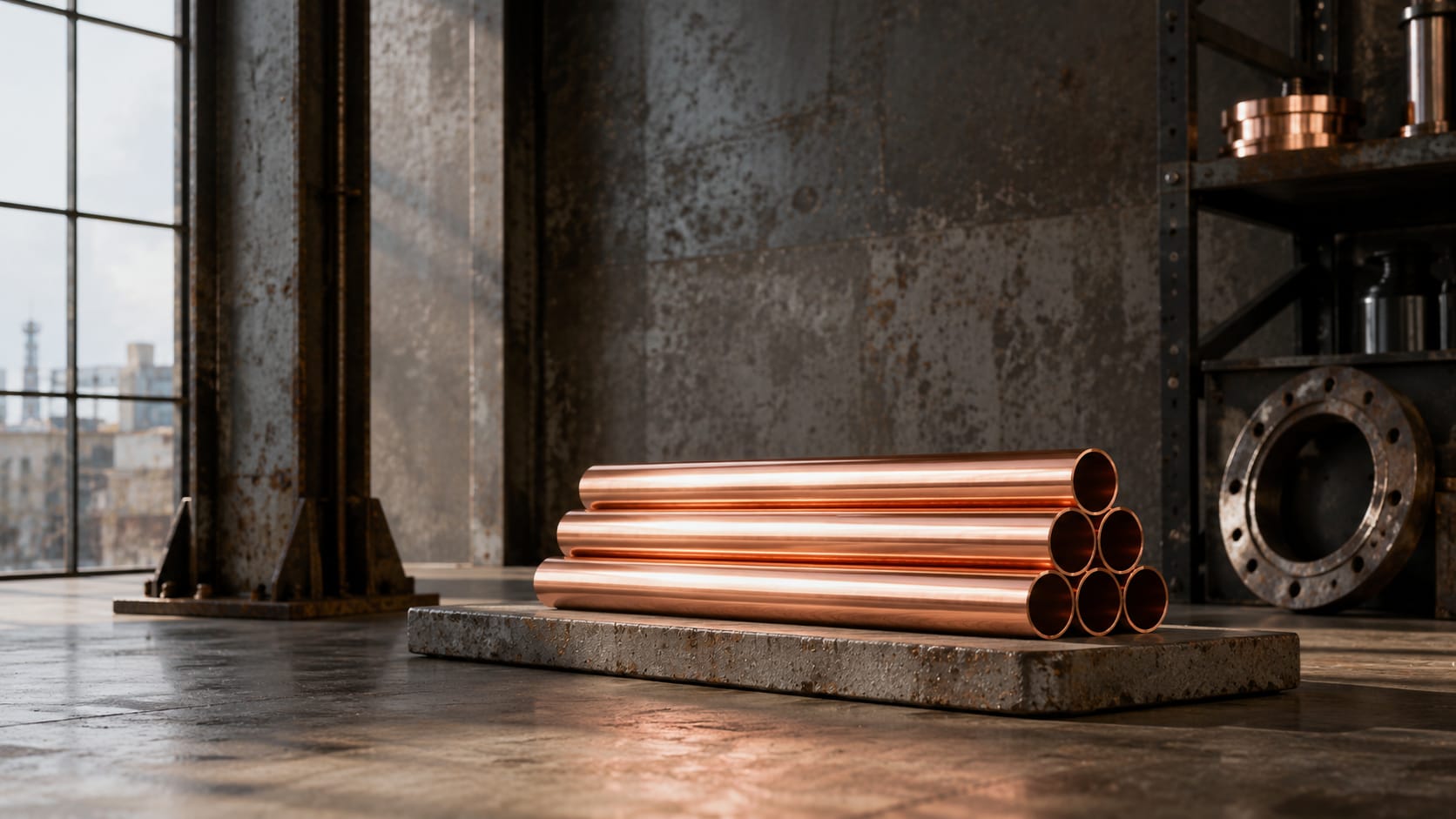
Cupro-Nickel 90/10 (also known as CuNi 90/10 or by its UNS designation C70600) is a copper-nickel alloy containing approximately 90% copper and 10% nickel. It is one of the most widely used corrosion-resistant alloys for seawater and marine applications.
This guide covers everything you need to know about CuNi 90/10 — from its composition and properties to its applications and the standards it must meet.
Chemical Composition
Cupro-Nickel 90/10 (UNS C70600):
The addition of iron (1-1.8%) is crucial — it dramatically improves the alloy's resistance to impingement attack and erosion-corrosion in flowing seawater, which is why iron content is carefully controlled.
Properties
Mechanical Properties:
Key Characteristics:
Marine and Industrial Applications
CuNi 90/10 is the material of choice for seawater systems:
Marine Applications:
Industrial Applications:
Why not just use stainless steel? While SS 316 has good general corrosion resistance, CuNi 90/10 has better biofouling resistance, is more resistant to crevice corrosion in low-velocity seawater, and doesn't suffer the same microbiologically influenced corrosion (MIC) issues as stainless steel.
Applicable Standards
CuNi 90/10 products are manufactured per these standards:
Pipes:
Tubes:
Fittings:
Flanges:
Starlight Tubes supplies CuNi 90/10 pipes per ASTM B466, tubes per ASTM B111, and fittings per ASME B16.22 with full Mill Test Certificates.
CuNi 90/10 vs 70/30 — When to Choose Which
CuNi 90/10 (C70600):
CuNi 70/30 (C71500):
Rule of thumb: Use 90/10 as your standard choice; upgrade to 70/30 only if the seawater conditions are particularly aggressive or flow velocities exceed 3.5 m/s.
Frequently Asked Questions
Q.What is Cupro-Nickel 90/10 used for?
CuNi 90/10 (C70600) is primarily used in seawater and marine applications including ship seawater piping systems, desalination plant condenser tubes, offshore firewater systems, heat exchangers, and power plant cooling systems. Its excellent resistance to seawater corrosion and biofouling makes it the preferred material for these applications.
Q.What is the difference between CuNi 90/10 and 70/30?
CuNi 90/10 (C70600) contains 10% nickel while 70/30 (C71500) contains 30% nickel. The higher nickel content in 70/30 provides better corrosion resistance and can handle higher seawater flow velocities (up to 4.5 m/s vs 3.5 m/s). However, 70/30 costs 30-50% more. Use 90/10 as the standard choice and upgrade to 70/30 for aggressive conditions.
Related Product Specifications
Require Technical Data or Immediate Quotation?
Starlight Tubes supplies these exact specifications with 100% EN 10204 3.1 MTC traceability and rapid worldwide dispatch.